
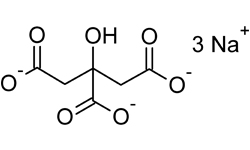

Sodium Citrate

Sodium Citrate (Trisodium Citrate) Chemical Formula

Description
Sodium Citrate is mainly used as an expectorant and a urine alkanizer. It is also used as a pharmaceutical aid and as a food additive in Dairy Industries which cater in Cheese Manufacturing and Beverages. It is also a water treatment chemical and as a Laboratory Reagent.
Applications and Effect
Our product helps in the storage of all the Dairy products especially cheese. It can prevent the dairy products from getting stale for 90 days than compared to other solutions. If it is used in water then can prevent the growth of bacteria for 15 days.

Specifications

USP
BP
IP
JP
KP
USP
Daffodil Pharmachem

TestsSpecifications
DescriptionColorless crystals or white, crystalline powder.
SolubilityFreely soluble in water and very soluble in boiling water. Insoluble in alcohol.
IdentificationA) solution (1 in 20) responds to the test for Sodium and for citrate.
Sodium: A dense precipitate is formed.
Citrate: A light red colour is produced.
AlkalinityNo pink colour is produced by 1 drop of phenolphthalein TS.
WaterBetween 10.0% and 13.0%. Dry it at 180°C for 18 hours.
AlkalinityNot more than 0.2 ml of 0.1M hydrochloric acid or 0.1M sodium Hydroxide is required to change the colour of the indicator.
TartrateNo crystalline precipitate is formed.
Heavy MetalsNot more than 0.001%.
Assay99.0 % to 100.5 % (On Anhydrous Basis)
BP
IP
JP
KP

FAQs (Frequently Asked Questions)

Sodium citrate acts as an anticoagulant by chelating, or binding, free calcium ions in the blood. Sodium citrate prevents blood from clotting by locking onto calcium. Since blood needs calcium to clot, removing it keeps blood fluid and safe during medical procedures like transfusions and dialysis.

Sodium citrate is the sodium salt of citric acid. It is alkaline, mildly salty in taste, and functions as a buffer and emulsifier. Citric acid is the parent organic acid. It is sour, acidic, and primarily used as a flavoring and preservative. Despite sharing the citrate backbone, they serve distinct roles across food, pharma, and industrial applications.

Yes. Sodium citrate is recognized as Generally Recognized As Safe (GRAS) by the U.S. Food and Drug Administration (FDA) and is approved as a food additive in the European Union under the code E331. It is also permitted under Codex Alimentarius standards globally, making it one of the most universally approved food and pharmaceutical ingredients in the world.

en_USEnglish
