
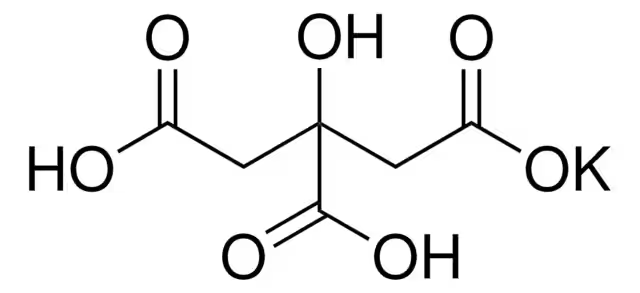

Potassium Citrate

Potassium Citrate

Description
Potassium Citrate (also known as Tripotassium Citrate) is the potassium salt of citric acid. It appears as white, granular crystals or a transparent crystalline powder with a characteristic saline taste. It is odourless and hygroscopic in nature, readily absorbing moisture from the surrounding air. One gram dissolves in approximately 0.5 mL of water. It is freely soluble in water, very soluble in boiling water, and practically insoluble in alcohol or ether.
Applications and Effect
Potassium Citrate is primarily employed as a urinary alkalizer in pharmaceutical applications, used to prevent and treat kidney stones (renal calculi) arising from uric acid, calcium oxalate, or cystine. It works by increasing urinary pH and urinary citrate levels, inhibiting the crystallisation and aggregation of stone-forming salts. Each gram provides 9.26 mEq of potassium. In food and beverage applications it acts as a buffer, pH regulator, sequestrant, and emulsifying salt (E332). It is also used as an electrolyte replenisher and in the treatment of metabolic acidosis.

Specifications

USP
BP
IP
JP
KP
USP
Daffodil Pharmachem

TestsSpecifications
DescriptionWhite, granular crystals or white crystalline powder; odourless; slightly deliquescent in moist air..
SolubilityFreely soluble in water; practically insoluble in ethanol (95%) and in ether.
Identification A – Citrates 1. A dense, white precipitate is formed. 2. A yellow, crystalline precipitate is formed.
Identification B  – PotassiumA white precipitate soluble in 6M acetic acid is formed. (Potassium reaction confirmed.)
Appearance of solutionSolution A is clear and colourless.
Acidity or alkalinityNot more than 0.5 mL of 0.05M sulphuric acid or 0.1M sodium hydroxide is required.
ArsenicNot more than 2 ppm.
Heavy MetalsNot more than 10 ppm.
Assay99.0% to 101.0% (on anhydrous basis)
BP
IP
JP
KP
en_USEnglish
