
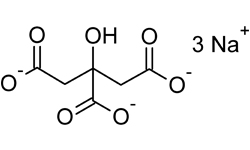


| Tests | Specifications |
|---|---|
| Description | Colorless crystals or white, crystalline powder. |
| Solubility | Freely soluble in water and very soluble in boiling water. Insoluble in alcohol. |
| Identification | A) solution (1 in 20) responds to the test for Sodium and for citrate. Sodium: A dense precipitate is formed. Citrate: A light red colour is produced. |
| Alkalinity | No pink colour is produced by 1 drop of phenolphthalein TS. |
| Water | Between 10.0% and 13.0%. Dry it at 180°C for 18 hours. |
| Alkalinity | Not more than 0.2 ml of 0.1M hydrochloric acid or 0.1M sodium Hydroxide is required to change the colour of the indicator. |
| Tartrate | No crystalline precipitate is formed. |
| Heavy Metals | Not more than 0.001%. |
| Assay | 99.0 % to 100.5 % (On Anhydrous Basis) |

| Tests | Specifications |
|---|---|
| Appearance | White or almost white, crystalline powder or white or almost white, granular crystals, slightly deliquescent in moist air. |
| Solubility | Freely soluble in water, practically insoluble in ethanol (96 %). |
| Identification A. Citrates B. Sodium | 1. Violet colour, turning to violet-blue is produced. 2. A white precipitate soluble in 6M acetic acid. |
| Identification B. Sodium | 1. A dense, white precipitate is formed. |
| Appearance of Solution | Solution S is clear and colourless. |
| Acidity or Alkalinity | Not more than 0.2 ml of 0.1M hydrochloric acid or 0.1M sodium Hydroxide is required to change the colour of the indicator. |
| Readily Carbonisable Substances | The solution is not more intensely coloured than reference solution Y2 or GY2. |
| Chloride | Not more than 50 ppm |
| Oxalate | Not more than 300 ppm (calculated as anhydrous oxalic acid). |
| Sulphate | Not more than 150 ppm |
| Heavy Metals | Not more than 10 ppm |
| Water | 11.0 per cent to 13.0 per cent, determined on 0.300 g. |
| Assay | 99.0 % to 101.0 % (On Anhydrous Basis) |

| Tests | Specifications |
|---|---|
| Description | White, granular crystals or white crystalline powder; odourless; Slightly deliquescent in moist air. |
| Solubility | Freely soluble in water; practically insoluble in ethanol (95%) and in ether. |
| Identification A. Citrates | 1. A dense, white precipitate is formed. 2. A yellow, crystalline precipitate is formed. |
| Identification B. Sodium | 1. A white precipitate soluble in 6M acetic acid. |
| Appearance of Solution | Solution A is clear and colourless. |
| Acidity or Alkalinity | Not more than 0.5 ml of 0.05M sulphuric acid or 0.1M sodium Hydroxide is required. |
| Arsenic | Not more than 2 ppm |
| Heavy Metals | Not more than 10 ppm |
| Chloride | Not more than 100 ppm |
| Oxalate | Not more than 300 ppm (calculated as anhydrous oxalic acid). |
| Sulphate | Not more than 150 ppm |
| Tartrate | No crystalline precipitate is formed. |
| Readily Carbonisable Substances | The solution is not more intensely coloured than reference Solution YS2 or GYS2. |
| Water | 11.0 to 13.0 per cent, determined on 0.3 g. |
| Assay | 99.0 % to 101.0 % (On Anhydrous Basis) |

| Tests | Specifications |
|---|---|
| Description | White, granular crystals or white crystalline powder; odourless; Slightly deliquescent in moist air. |
| Solubility | Freely soluble in water; practically insoluble in ethanol (95%) and in ether. |
| Identification A. Citrates | 1. A dense, white precipitate is formed. 2. A yellow, crystalline precipitate is formed. |
| Identification B. Sodium | 1. A white precipitate soluble in 6M acetic acid. |
| Appearance of Solution | Solution A is clear and colourless. |
| Acidity or Alkalinity | Not more than 0.5 ml of 0.05M sulphuric acid or 0.1M sodium Hydroxide is required. |
| Arsenic | Not more than 2 ppm |
| Heavy Metals | Not more than 10 ppm |
| Chloride | Not more than 100 ppm |
| Oxalate | Not more than 300 ppm (calculated as anhydrous oxalic acid). |
| Sulphate | Not more than 150 ppm |
| Tartrate | No crystalline precipitate is formed. |
| Readily Carbonisable Substances | The solution is not more intensely coloured than reference Solution YS2 or GYS2. |
| Water | 11.0 to 13.0 per cent, determined on 0.3 g. |
| Assay | 99.0 % to 101.0 % (On Anhydrous Basis) |

| Tests | Specifications |
|---|---|
| Description | White, granular crystals or white crystalline powder; odourless; Slightly deliquescent in moist air. |
| Solubility | Freely soluble in water; practically insoluble in ethanol (95%) and in ether. |
| Identification A. Citrates | 1. A dense, white precipitate is formed. 2. A yellow, crystalline precipitate is formed. |
| Identification B. Sodium | 1. A white precipitate soluble in 6M acetic acid. |
| Appearance of Solution | Solution A is clear and colourless. |
| Acidity or Alkalinity | Not more than 0.5 ml of 0.05M sulphuric acid or 0.1M sodium Hydroxide is required. |
| Arsenic | Not more than 2 ppm |
| Heavy Metals | Not more than 10 ppm |
| Chloride | Not more than 100 ppm |
| Oxalate | Not more than 300 ppm (calculated as anhydrous oxalic acid). |
| Sulphate | Not more than 150 ppm |
| Tartrate | No crystalline precipitate is formed. |
| Readily Carbonisable Substances | The solution is not more intensely coloured than reference Solution YS2 or GYS2. |
| Water | 11.0 to 13.0 per cent, determined on 0.3 g. |
| Assay | 99.0 % to 101.0 % (On Anhydrous Basis) |

| Tests | Specifications |
|---|---|
| Definition | Trisodium 2-hydroxypropane-1,2,3-tricarboxylate dihydrate. |
| Content | 99.0% to 101.0% (anhydrous substance). |
| Appearance | White or almost white, crystalline powder or white or almost white, granular crystals; slightly deliquescent in moist air. |
| Solubility | Freely soluble in water; practically insoluble in ethanol (96%). |
| Identification | Tests for sodium and citrate comply with the requirements of the monograph. |
| Appearance of solution | The solution is clear and colourless. |
| Acidity or alkalinity | Complies with the requirements of the Ph. Eur. test. |
| Chlorides | Not more than 50 ppm. |
| Sulfates | Not more than 150 ppm. |
| Water | 10.0% to 13.0%. |
Lorem ipsum dolor sit amet, consectetur adipiscing elit. Ut elit tellus, luctus nec ullamcorper mattis, pulvinar dapibus leo.
Quality You Can Rely On
Every batch is produced under controlled manufacturing and quality processes designed to deliver consistent product performance. Our technical documentation and quality information help European customers evaluate, qualify and source Sodium Citrate with confidence.
Dependable Supply Across Europe
With established manufacturing capabilities and international supply experience, Daffodil Pharmachem supports customers across European markets with reliable product availability, responsive coordination and technical assistance throughout the sourcing process.
Sodium Citrate, known as E331 in the European Union, is used as a functional food additive in a range of applications where acidity regulation, buffering and formulation stability are important. For European food manufacturers, its use is subject to the EU food-additive framework, including authorised uses and conditions of use under Regulation (EC) No 1333/2008.
Frozen Desserts
Supports formulation control and helps maintain consistent product characteristics.
Jam & Fruit Preparations
Used for acidity and pH control in selected fruit-based formulations.
Beverages
Used as an acidity regulator and buffering agent in suitable beverage applications.
Bakery Products
Used in selected formulations where acidity and processing characteristics need to be controlled.
Processed & Melted Cheese
Used as a functional salt in certain processed cheese applications to support texture and formulation stability.